

Have you ever wondered what actually happens under your sink when you turn on your drinking water faucet?
This is the full journey of water through a reverse osmosis system.
Step by step.
Everything starts with your cold water line.
This is the starting point for filtration.
The first filter is the sediment filter.
If sediment reaches the membrane, it shortens its life. This filter helps prevent that.
Next, water flows through a granulated activated carbon filter.
This step helps protect the core of the system.
This is the heart of the system.
This is what makes it a true reverse osmosis system.
Without this membrane, it’s not reverse osmosis.
After purification, some systems add minerals back in.
Think of it like a daily vitamin for your water.
Clean water moves into the storage tank.
This tank is why reverse osmosis systems deliver water when you want it.
If the faucet or refrigerator is far from the tank, a pump may be used.
Not every setup needs one, but longer distances often do.
Before water reaches your glass, it passes through one final stage.
This step gives the water its final touch.
After all that filtration, water reaches your faucet.
Every drop has passed through multiple stages designed to improve water quality and taste.
Reverse osmosis systems are a great option for any drinking water source.
Municipal water. Well water. Refrigerator lines.
If it’s water you drink, reverse osmosis can help.
You don’t have to guess about your drinking water.
Call 973-697-6055 to schedule your free water consultation.
Clear answers. No pressure. Better drinking water starts with a simple call.
Why keep wondering what’s coming out of your tap?
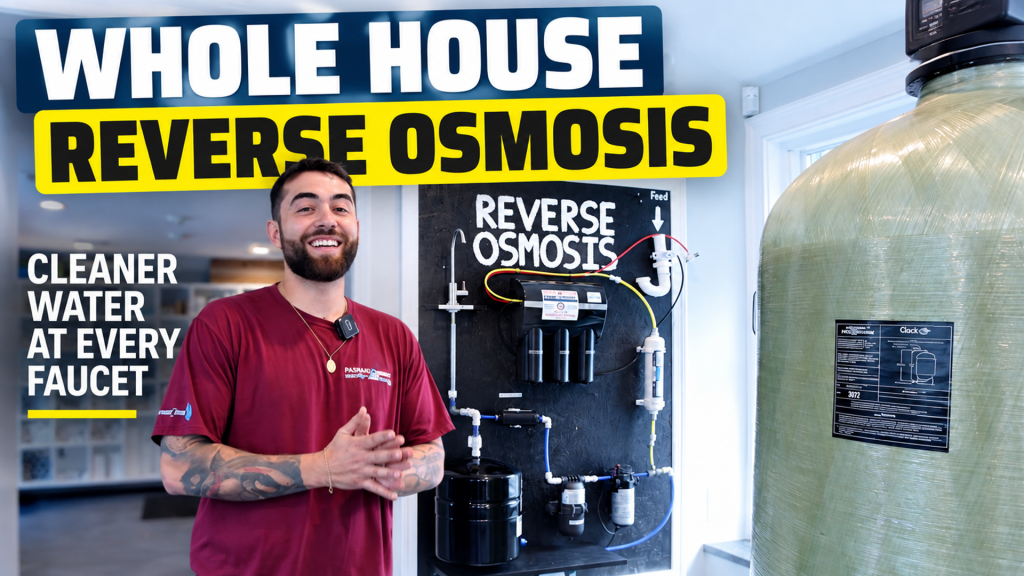
https://youtu.be/_-65lTrCOu0 Most people are familiar with reverse osmosis systems that install underneath a kitchen sink. These systems provide filtered water for drinking and cooking from one dedicated faucet. But what if you want that same type of water throughout your entire home? That is where a whole house reverse osmosis

Most homeowners never think about their water softener drain. They assume if the system is producing soft water, everything is working properly. During this installation, we discovered a much bigger problem than an aging water softener. The drain had been installed incorrectly and needed to be completely redesigned. Watch the